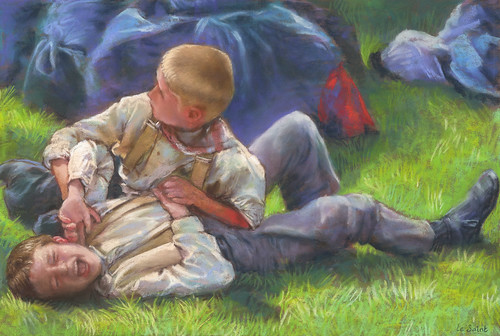
When starting to work on a new pastel I have no single method. I may start with a sketch of outlines in Sepia. or I may apply colours directly and work with shapes both of the actual subject and of negative space. I might instead place light on a dark background and work from there, or start any other way.
Then comes a choice between two extremes that could be called caution and boldness. Each approach has its drawbacks. Be too cautious and the result feels contrived. On the other hand be too careless and you get proportions all wrong. The problem being that you don't realize it right away : the eye gets used to errors and only by looking at your drawing in a mirror do you see your mistake...
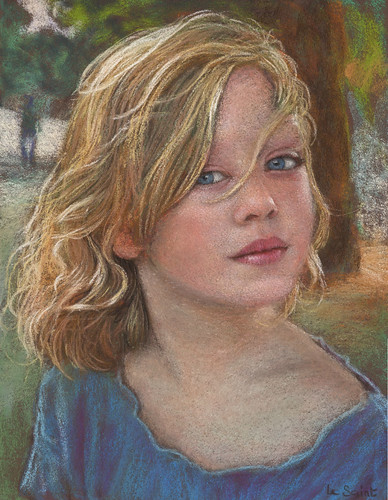
Often there is no conscious decision on how to proceed, the subject makes it self evident. In this case I had to work in loose strokes. It has its advantage, namely, I didn't have to worry too much about when to stop : It soons become difficult to work on details when the surface is saturated with layers of pastel quickly applied one on top of the other. It would still be possible to add detail using one trick or another, but I think it would ruin the "rough" look of the pastel as a whole.
sold

"He started it" 091124


"Chat de Marrakech" Pastel #626
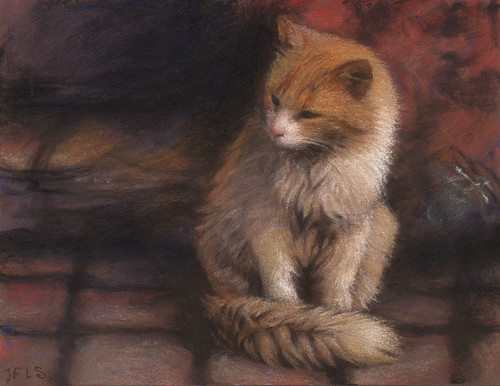
"Cat in the streets of Marrakech" Pastel on pastelcard, 32.5x25cm.
Walking the streets of Marrakech in the morning, when few shopkeepers have started to set up their display, the souk area belongs to cats, their sight agreeable against the background of the ochre city.
available
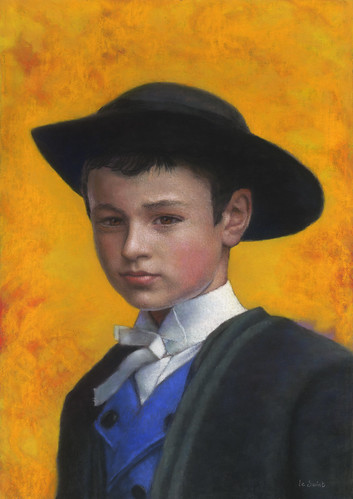
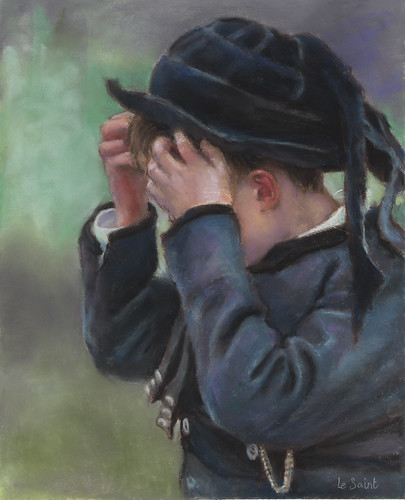
"Boy" 080907
Pastel portrait of a young breton boy in traditional clothes from Guérande
30x40cm
Most of the years I have spent experimenting with pastels since 1990, I have done so on Pastelcard (also called La Carte pastel), it has a rough, fragile texture that feels like sand paper with a fine grain.
Over the years I have tried many approaches. Applying pastels to the point of saturation and blending with my fingers was my first experiment. Until I decided I would use as little pastel as I could, so as to better control each stroke. After some time I wanted a different result, I applied looser strokes, and never blending. Then I wanted my pastels to look best under low light, so I started all my drawings in creamy white, adding colour on top... Of course, during those years, I also experimented on other kinds of papers, but it never lasted long. After years working on pastelcard, I could work almost to the point of saturation with soft pastels before blending with harder pastels, and I could still add final strokes to obtain the result I wanted.
In the end, it seems It was I who had saturated, I could do what I wanted, but I no longer wanted to.
This happened last year. For several months I turned to painting in oil. Then, something great happened. I was given several sheets of Pastelmat as a gift, a new (new to me) kind of paper, basically of the same type as pastelcard, but with a completely different feel. It is very soft to the touch, and is not fragile. It saturates faster, and has other shortcomings, but it was a welcome challenge. All of a sudden I put my oils aside, and started experimenting on the new paper with enthusiasm.
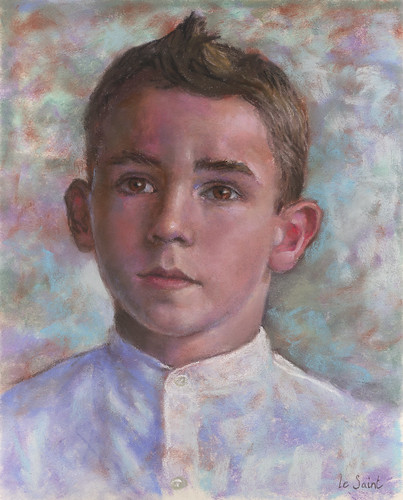
This pastel portrait on a yellow background was the first of a long series, and I am happy to say that after more than a year I still don't know the full potential of the new paper. My time with oils has also given me new insight, and I am happy to pick up a sheet of the good old Pastelcard once in a while with renewed interest.
The original is sold, it is hanging in a local "Crêperie", but it is possible to order a print at Imagekind
30x40cm
Most of the years I have spent experimenting with pastels since 1990, I have done so on Pastelcard (also called La Carte pastel), it has a rough, fragile texture that feels like sand paper with a fine grain.
Over the years I have tried many approaches. Applying pastels to the point of saturation and blending with my fingers was my first experiment. Until I decided I would use as little pastel as I could, so as to better control each stroke. After some time I wanted a different result, I applied looser strokes, and never blending. Then I wanted my pastels to look best under low light, so I started all my drawings in creamy white, adding colour on top... Of course, during those years, I also experimented on other kinds of papers, but it never lasted long. After years working on pastelcard, I could work almost to the point of saturation with soft pastels before blending with harder pastels, and I could still add final strokes to obtain the result I wanted.
In the end, it seems It was I who had saturated, I could do what I wanted, but I no longer wanted to.
This happened last year. For several months I turned to painting in oil. Then, something great happened. I was given several sheets of Pastelmat as a gift, a new (new to me) kind of paper, basically of the same type as pastelcard, but with a completely different feel. It is very soft to the touch, and is not fragile. It saturates faster, and has other shortcomings, but it was a welcome challenge. All of a sudden I put my oils aside, and started experimenting on the new paper with enthusiasm.
This pastel portrait on a yellow background was the first of a long series, and I am happy to say that after more than a year I still don't know the full potential of the new paper. My time with oils has also given me new insight, and I am happy to pick up a sheet of the good old Pastelcard once in a while with renewed interest.
The original is sold, it is hanging in a local "Crêperie", but it is possible to order a print at Imagekind
Subscribe to:
Posts (Atom)